Silchar 2026: When Candidate Selection Becomes BJP’s Biggest Test
Silchar 2026: When Candidate Selection Becomes BJP’s Biggest Test” captures a moment where the election is no longer just about party strength, past victories, or broad ideological appeal—it is about a single, decisive factor: who represents the party on the ground.
Bureau News, Hype Headline
3/30/20263 min read

Silchar has long been considered a BJP fortress in Barak Valley. The numbers support that perception. In the 2021 Assembly election, Dipayan Chakraborty secured a decisive victory with over 56% vote share and a margin exceeding 37,000 votes.
The BJP has steadily grown its lead in the constituency over time, even at the parliamentary level, demonstrating strong electoral consolidation.
Yet, elections are not fought on past numbers alone. They are fought based on perception, sentiment, and, most critically, candidate selection.
And this is precisely where the 2026 battle in Silchar begins to look different.
From Dipayan to Rajdeep: A Strategic Gamble or Structural Misstep?
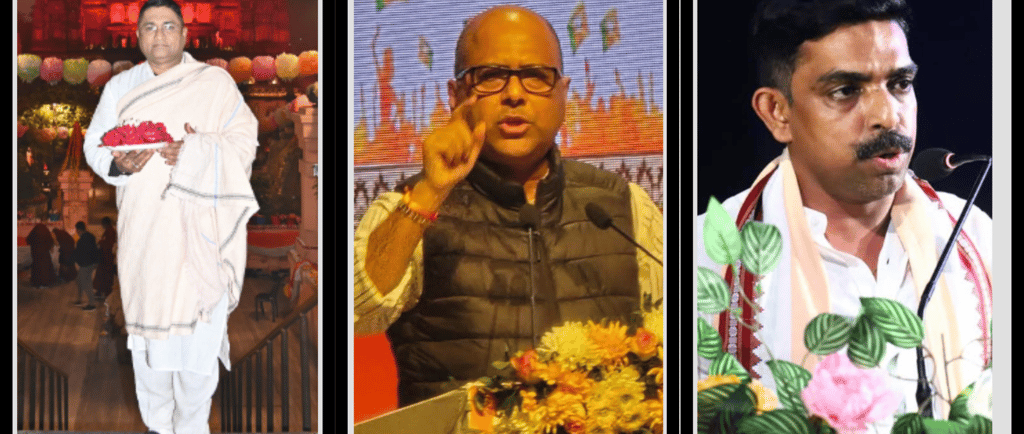
The BJP has replaced sitting MLA Dipayan Chakraborty with Rajdeep Roy for the 2026 Assembly election.
At first glance, the move may appear like a strategic upgrade; Rajdeep Roy is a former Lok Sabha MP with a known face and organizational experience.
But on the ground, and more importantly, on social media discourse emerging from Silchar, a different narrative is taking shape:
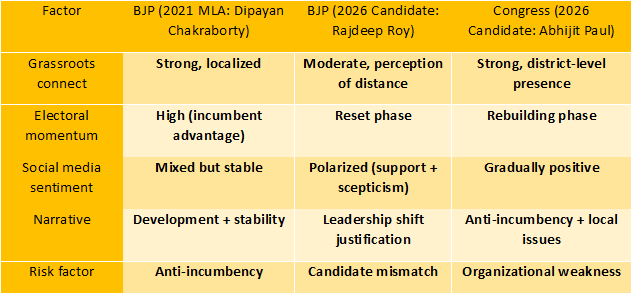
1. Disconnection vs. Continuity
Dipayan Chakraborty represented local continuity, having built networks at the ward level, youth groups, and municipal circuits.
Rajdeep Roy, despite his stature, is often perceived in online discussions as less rooted in grassroots day-to-day issues.
This distinction, “accessible MLA vs. high-profile candidate," is increasingly visible in comment sections and local digital debates.
2. The “Why Change a Winning Face?” Question
One recurring sentiment across local political chatter:
If the BJP were winning comfortably, why replace the MLA?
This question is politically dangerous, not because it has a single answer, but because it creates doubt.
Recent developments across Assam show that ticket denial often leads to internal dissatisfaction or even defections.
Even if no open rebellion occurs in Silchar, silent cadre disengagement can be just as damaging.
Congress Strategy: Quiet Consolidation vs BJP’s Loud Confidence
On the other side, Congress has fielded Abhijit Paul, a district-level leader with consistent grassroots activity in Barak Valley.
Unlike the BJP's high-visibility campaign style, Congress appears to be focusing on the following:
Local organizational rebuilding
Targeting “unfulfilled promises” narrative
Consolidating anti-incumbency sentiment
Comparative Snapshot
The Social Media Undercurrent: Subtle But Significant
Unlike previous elections, 2026 is witnessing hyper-local digital engagement:
Facebook groups in Silchar are increasingly debating “local vs outsider” narratives
Comment sections reflect the following:
Disappointment among a section of BJP supporters over ticket change
Growing curiosity, not necessarily full support, for Congress candidate
Troll narratives are shifting from opposition attacks to internal questioning within BJP circles
This is a crucial shift.
Because when a party’s own support base starts asking questions publicly, it signals fractures not necessarily visible on rally stages but present in voting booths.
The BJP Advantage Still Exists, But Is It Eroding?
Let’s be clear: BJP is not weak in Silchar.
Recent visuals of large rallies and mobilization show that the party still commands organizational strength and voter enthusiasm.
However, internal miscalculations often lead to election losses, not just opposition strength.
And candidate selection has historically been one of the biggest triggers.
The Emerging Question
Silchar 2026 is no longer a straightforward BJP stronghold battle.
It is evolving into a test of political intuition vs ground reality:
Did the BJP overestimate the transferability of votes from Dipayan Chakraborty to Rajdeep Roy?
Can Congress convert soft dissatisfaction into firm votes?
Will silent voters, often invisible on social media, decide differently?
Voters’ Call
In politics, opponents don't always take away victories.
Occasionally, they are relinquished through internal decisions.
Today, Silchar finds itself at a pivotal moment.
Whether this election becomes a reaffirmation of the BJP's dominance or a lesson in the cost of candidate miscalculation is something only the voter will decide.
Bureau Report, Hype Headlines